Tuesday, August 18, 2020

RED-S (Relative Energy Deficiency in Sport) quick take for endurance coaches


     My personal experience with RED-S covers most of my lifetime and for the majority of those years, I did not have an eating disorder. I simply wasn't keeping up on replenishing what I burned through training. Because my training volume is less that it has been in the past, I have not struggled with symptoms of RED-S since 2018. With a possible start in triathlon in 2021, I'll need to stay vigilant to keep it from coming back. The short paper below is a synopsis about what RED-S is, who is vulnerable to it and how coaches can prevent it.

     In 2014, the International Olympic Committee re-defined the term “female-athlete triad” to update the term with current and relevant information that acknowledges the role that the condition also plays in male athletics. They re-coined the condition as “RED-S” or “relative energy deficiency in sport.” They defined the condition as “impaired physiological function including, but not limited to, metabolic rate, menstrual function, bone health, immunity, protein synthesis, cardiovascular health caused by relative energy deficiency” (Mountjoy et. al., 2014). The cause is a depletion of energy that is available for optimal functioning due to an imbalance between training loads and nutritional intake.

     The IOC agrees that “EA (energy availability) is calculated as EI (energy intake) minus the energy cost of exercise relative to fat-free mass (FFM) and in healthy adults, a value of 45 kcal/kg FFM/day equates energy balance” (Mountjoy et. al., 2014). This precise measurement allows physicians and coaches to accurately define exactly how much their athletes need to take in to support healthy functioning while engaging in intense training.
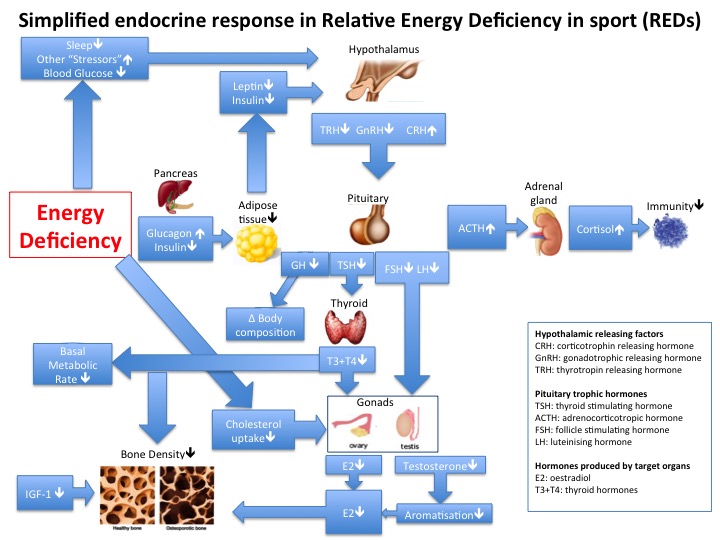
2018 UPDATE: Relative Energy Deficiency in Sport (RED-S) | BJSM ...

BMJ Blog

Who Is at Risk?

     All athletes, regardless of gender are potentially at risk of developing RED-S. This was part of the IOC’s mission in re-defining the term because it became obvious that men were being affected by the phenomenon as well. A 2019 study found that men who had high levels of exercise dependency were more likely to display eating disorder tendencies and lower energy levels due to their reduced energy intake. They also had higher cortisol vs. insulin levels, indicating a catabolic state (Torstveit et. al., 2019). Although we now know that men are at risk of RED-S, alongside women, it is female British teenage running phenom, Bobby Clay’s case that shows the significant impact of the IOC’s terminology change. Clay was one of the top junior runners in the world, claiming the 2015 European 1500m championship title after years of national domination. After breaking her foot from simply pushing off the wall in the pool in 2017, she underwent bone density tests that revealed she had osteoporosis (Athletics Weekly, 2017). This was followed by a series of stress and full fractures in her lower extremities that would happen during mundane activities like cycling and jogging on grass. She maintains that she never struggled with an eating disorder and that the main culprit to her hormonal disorder was overtraining combined with accidental under fueling (Let’s Get Running, n.d.). In my own personal coaching experience, it has been male athletes that struggled with RED-S. I had a series of athletes who trained together for at least a season who had unhealthy relationships with food and an extreme focus on remaining thin and lean during the season. I referred two of them to speak with their doctors about the obsessive behavior.    


What are the Signs of RED-S?

     It is important to note that only medical professionals can diagnose and treat RED-S but it equally important for coaches to be aware of the signs:

·         Decreased glycogen stores

·         Decreased muscle strength

·         Decreased endurance performance

·         Increased injury risk

·         Decreased training response

·         Impaired judgment

·         Decreased coordination

·         Decreased concentration

·         Irritability

·         Depression

(British Journal of Sports Medicine, 2015).


Because RED-S may be exacerbated by an eating disorder, coaches should also be aware of unhealthy relationships with food. This is not easy to recognize as a coach. Parents, siblings and teammates may have better insight into this. Athletes do not have to have all of the markers to land in the “moderate risk” zone as defined by the British Journal of Sports Medicine. They could have only one or two risk factors and qualify for intervention by a team of health care providers including a dietician, sports medicine doctor and psychologist. It is important not to stigmatize RED-S and approach recovery in a positive manner, emphasizing how important recovery is to performance and overall health.

What are the Consequences of RED-S?

     The ultimate consequences for an athlete are reduction in the level of performance due to the body breaking down and being unable to sustain endurance training. But there are also consequences outside of sport that may affect an athlete’s health for the rest of his or her life.

·         Immunological

·         Gastrointestinal

·         Cardiovascular

·         Psychological

·         Growth + development

·         Hematological

·         Menstrual function

·         Bone health

·         Endocrine

·         Metabolic


(British Journal of Sports Medicine, 2015).


     Because hormonal function is integral to the body’s entire system, RED-S victims can see a wide range of health consequences, with the most severe cases leading to bradycardia (low heart rate) and dangerously low bone density that may lead to osteoporosis.

What Can Coaches do to Combat RED-S?

     Information combined with a healthy approach to training is the best defense against RED-S becoming a problem on your team. Ply your team with information about healthy eating habits that support endurance training and emphasize the need for adequate nutrition for optimal performance. Print out team USA’s “Athlete’s Plate” handouts and post them in the locker room for athletes to use as a guide (Team USA, n.d.). Bring in a sports nutritionist to speak with the athletes and answer their questions. Gradually increase their training load as they age in order to help them keep an AE equilibrium. Youth athletes are an inspired, driven bunch who are always looking for ways to improve their performance. If they know that taking care of their energy needs will lead to increased performance, they will follow those guidelines. Finally, be a good example for them by taking care of your own nutritional needs. If they watch you counting calories at a team spaghetti dinner or conversely, downing a coke and candy bar while overseeing practice, they may conclude that fueling is not an important factor.

Team USA Athlete's Plate


References

Bobby Clay – my osteoporosis nightmare. 2017. Athletics Weekly. Retrieved from https://www.athleticsweekly.com/performance/bobby-clay-my-osteoporosis-nightmare-70422/

Coping with RED-S and disordered eating: Bobby Clay. (n.d.). Let’s Get Running Podcast. Retrieved from https://www.letsgetrunning.co.uk/coaches-log/reds-bobby-clay

Mountjoy, M., Sundgot-Borgen, J., Burke, L., Carter, S., Constantini, N., Lebrun, C., Meyer, N., Sherman, R., Steffen, K., Budgett, R. & Ljungqvist, A. (2014). The IOC consensus statement: beyond the female athlete triad – relative energy deficiency in sport (RED-S). British Journal of Sports Medicine, 48, 491-497.

Mountjoy, M. et. al. (2015). RED-S CAT. British Journal of Sports Medicine. Retrieved from https://bjsm.bmj.com/content/bjsports/49/7/421.full.pdf

Nutrition. (n.d.). Team USA. Retrieved from https://www.teamusa.org/nutrition

Torstveit, M., Fahrenholtz, I., Lichtenstein, M., Senqvist, T., & Melin, A. (2019). Exercise dependence, eating disorder symptoms and biomarkers of Relative Energy Deficiency in Sports (RED-S) among male endurance athletes. BMJ Open Sport Exercise Medicine, 5(1), doi: 10.1136/bmjsem-2018-000439

Wednesday, August 12, 2020

I won Johnnycake!

What: Johnnycake Jog 5 miler 

When: July 12, 2020

Where: Painsville, OH

Time: 32:30 (6:30 pace)

Splits: 6:14, 6:40, 6:11, 6:28, 6:40

Results: https://www.athlinks.com/event/5849/results/Event/901879/Course/1758950/Bib/395 

Link to the News Herald article: https://www.news-herald.com/sports/medina-resident-renee-harden-wins-johnnycake-jog-womens-division/article_b59b08f8-c466-11ea-bafe-2b5b76c5509e.html

When Covid hit in March, I quickly realized that I wouldn’t be racing much in the summer and decided to stop doing workouts that might beat my body down unnecessarily. I kept running 40-50 miles a week and doing a faster effort of some type once a week. I kept running my Thursday workouts with Todd and in May I began meeting my friend Amanda and the Portage Lakes Running Club to run 14-16 miles on the towpath. These long runs built some surprising strength and now after a few months of it, I sort of feel like a long distance runner. In June, I got wind that the Johnnycake Jog 5 miler was still happening as a live race. I registered, hoping it would go forward and did about three workouts in June to prepare myself. I knew I was not in great shape going into it, but I was fine with that. I was so excited to race!

I arrived in Painsville nearly an hour before I needed to and was one of the first masked participants to pick up my race packet. The building where they have packet pickup was very sparse, with just the bib table with several masked volunteers. It was a “socially distant” race format with masks for packet pickup, no awards or post-race party and the race started in waves every few minutes. This is ironic because both times I’ve run this race in 2014 and 2019 I’ve been socially distant from any other runner the whole race. This is not ideal under normal circumstances! 

The race was smaller than usual and I could tell that not as many fast women were there compared to a normal year. Usually you have to run under 30 minutes to finish in the money. I’ve won my age group here twice, but I wasn’t expecting to be in a position to win. Everyone who predicted 40 minutes and under started in the first wave but there weren’t very many of us. Otherwise, the start seemed normal. I wanted around a 6:15-6:20 average and I thought this seemed very doable but this course has been difficult for me to figure out. I went out with a 6:14 and this felt in control. I was bouncing along on my New Balance Rebel TCs (carbon plate) and feeling pretty smooth. There was one lady ahead of me but only by a few seconds per mile. I decided to try and catch her in the third mile and kept my eye on her. I didn’t realize I slowed down the second mile, but I apparently ran a 6:40. We run through shaded, attractive neighborhoods and it doesn’t seem like a race atmosphere. In the third mile I moved hard to catch her as I could see she had slowed down. I caught her right at three miles (6:11) and told myself that I wasn’t allowed to get lazy just because I was in the lead. But I was feeling hot, the road stretched out ahead of me forever, I was pretty out of shape for this effort and in classic Johnnycake Jog fashion, I was all alone. Then a guy caught me in the fourth mile (6:28) and I began pacing with him. He was very encouraging down that 1.75 mile stretch to the finish line and I’m sure I would have slowed down much more if I didn’t have his company. My last mile was 6:40 and when I saw the tape at the finish I couldn’t help but kick it in and give a big smile with my hands up. I thought that was the first time I’d broken the tape but I remembered later that I broke the tape a few times as a teenager in local races in Michigan. They used to do that a lot more! I won $100 for my efforts and that is almost as good as the super cool finish pic. I didn’t miss the awards or the post-race snacks. I did a quick interview with the News-Herald and headed out for my cooldown, during which I nearly died of starvation. Maybe I do miss the post-race snacks?! So I made sure to hit up McDonalds right down the street before I headed back home. I’ll be back next year Johnnycake! Hopefully the snacks will be back.


Sunday, September 9, 2018

On tibial stress fracture recovery, strength training and being a swimmer/runner

I haven't posted in here in a long time! This is a long-winded blog post, so be fore-warned.

     I was officially cleared for running from my tibial stress fracture in January after seeing Dr. Crawford at Summa in Medina. That was my first clearance but I wasn't able to complete the "return to pounding" protocol that he gave me. Instead of walking every other day for 20 minutes, I would walk every 5 days for 10 minutes and still be in pain. I was cleared again when I saw him six weeks later. And then again in April and in May. Each time I would attempt a few runs, even string together a couple of weeks of every other or every two days. But in the end I would end up in the boot, unable to get through my daily life without it due to the pain. Constant, burning, grinding pain that worsened as the day went on. I never had new bruising, but hot spots would creep in after a couple of weeks of running. I changed my eating (more calories, higher nutrients), took prescription vitamin d for 12 weeks, calcium and phosphorous supplements, cross trained like a maniac, did specific pt routines to strengthen my ankle. None of it worked.
     Every time running failed, swimming was still there for me. I competed in my first full U.S. Masters season and set prs from 50 yards to 1500 meters. I loved working out in the pool with the Medina Masters Swim Club, where I had some of the hardest workouts of my life. At my final meet of the season, Adam and the kids came to watch me. I think they enjoyed it more than watching me run!
"I have no idea why I entered 5 events."

     Speaking of pain, the past year and a half have been nothing but constant, chronic pain from my back and then my stress fracture. It seriously changes your lifestyle when something is this persistent. I had routines of stretching, rolling, icing and modified everything, including simple tasks like cleaning my house. I had to wear an ice cast to get housework done at the end of the day.
     Starting in March, I discontinued coaching with Becki. I should have taken a break from being coached the minute I got my stress fracture, in order to better listen to my body and do only what I felt like doing. I found myself relaxing a lot more on my own. I also started my own coaching education in December and moved on to USATF Level 2 by this summer, so I now have all the knowledge I need to coach myself in the future. A little more on this topic of being coached long distance as an adult: unless you can find someone that will work exactly with your specific work schedule and lifestyle, don't do it. Only you know what you feel like from day to day and what days work for workouts and long runs. If you're like me and will do what's on the training schedule come hell, high water, all day cross country meet or a fucking herniated disc, you're better off training by feel with your own plan. And, if you're exhausted in a marathon after a 3 month training block, it's more likely that you did too much, rather than you didn't do enough. Pump the breaks before something really goes wrong, like a stress fracture. That all being said, Becki had the best road speed workouts that I've ever done and I'll continue to do them on a less frequent basis if I ever get back to serious run training.
     After many failed attempts, I returned to running for good in mid-July, nearly 11 months after my stress fracture. I was smack dab in the middle of my first open water swimming season, if two races qualifies as such. I swam my first 2 miler in July and my first 5k in August. My 5k was the best I've ever felt on a swim and I smashed my predicted time by 4 minutes: Swim to the Moon 5k results
All I could think during that 5k was that I've found an activity that I love at least as much as running. I felt amazing, so strong through the miles and found myself hunting people down during the last 1k, just like I love to do in running races.
Feeling like a water horse! That's much beastlier magical creature than a mermaid.

      Seven weeks after I started back to running, I'm still under 30 miles a week and I have no plans to up the mileage. I have a 5k coming up and in November I'll run the Bills Bad Ass 50k for the final time. I'm upping my long run by 10 minutes every week until I hit 3 hours on the trails. I swim about 12,000m a week with the focus switching more to the pool for the 2019 U.S. Masters swim season. At first I was conflicted on which sport to choose, but I've decided that I don't need to choose. I love them both and I'm going to compete in both to the best of my ability. I don't care if it means I sacrifice future running prs, I know I have a lot to improve in the pool and in the open water and I want to see how far I can go. Of course, I'm confident enough in my running ability that I think I can still set some road prs! Especially at the shorter distances.
  
     Over the winter I started lifting with a serious focus on Olympic lifts and single leg balance. I purchased performance training sessions from Ohio Sports Chiropractic and Rehab. Brian helped me perfect my form for the Olympic lifts and convinced me to up the squat weight to a previously impossible (I thought) weight of 105 pounds! That's nearly my weight! I have since upped it to 110 pounds and I will be adding to that this winter.
     This summer I tried to actively gain weight and build muscle in my upper body. I didn't gain much weight (3 pounds) but I have built my upper body to a size that I would never have thought possible a year ago. I recognize that my genetics are going to hold me back from building to the size that I see on the women going out in the elite wave at open water races, but I know that working on this will improve my swimming and my overall physical well-being as an athlete. I also was able to come back to running with faster daily paces than when I was half-injured and running 80 miles a week last summer. Not being exhausted from high mileage has it's perks! Below I've outlined my light and heavy lifts and my daily ab and pt routines.

Daily ab and pt routine:
200 crunches
pilates 100x2
50 bicycles
50 russians
50 side crunches each side
50 sit ups
30 second bridge, 20 second each side single leg bridge 
15 x ab roller w/ long holds
20 pushups
1 min plank, 30 second each side plank
20 bird dogs each side
10 donkey kicks each side
10 fire hydrants each side 
single leg sequence w/ thera bands
30 second single leg hold with eyes closed
rotator cuff activation x 10 w/ thera bands
nerve flossing for bicep, rotator cuff and scapular spine

Light lift 3 days a week:
10 minute warmup on bike
20 x kettlebell swings w/ 15lbs
20 x squats w/ kettlebell 15lbs
20 x each side single leg romanian dl w/ 15lbs
20 x each dynamic single leg toe touch w/ 10lbs
20 x reverse flys w/ 10lbs each side
20 x bicep curls w/ 10lbs each side

Heavy lift 1-2 days a week:
10 minute wamup on the bike
TRX upper body sequence x 12 (2 sets)
5 x reverse pullups w/ 1-5 second holds at the top
5 x pullups on straight bar
10 x chinups on straight bar
5 x single leg toes to the bar each leg
3 x 10 straight bar squats 55-105 lbs
2 x 10 straight leg dl 50 lbs
2 x 10 dynamic single leg toe touch w/ 10 lbs
20 x eccentric heel drops w/ 10lbs
20 x calf raises
10 x single leg calf raises each side on step
pushup challenge: 35 pushups, 30 second plank, 20 pushups, 30 second plank, 10 pushups, 30 second plank
20 bosu ball squats with 14lb medicine ball
10 x dynamic single leg on soft bosu ball

Side plank. Okay, I feel bigger than I look I guess.
I think this is supposed to be a squat but I should be looking up!

Kettle bell swings.


Wednesday, November 29, 2017

The 12 Weeks of Tibia Healing

     And on the 12 week of tibia healing my true love (me, myself and I?) gave to me...an MRI. Finally! Dr. Matt and Dr. Leo at Ohio Sports Chiropractic and Rehab suggested I get an MRI eight weeks post-stress fracture because healing was so delayed. I didn't want to drop the (very reasonable) $295 so I waited until I got through two failed attempts to return to light running before I caved and got the order. My main worry was that if I needed surgery, I'd better get on it and not delay any longer.
     I used Precision Diagnostic Imaging in Medina. They got me an appointment within one week of calling them and I only waited 15 minutes to be taken back for imaging. I wasn't prepared for the half hour to 40 minutes in the machine as all the images were being taken. Or for the intense magnetic tingling in my leg! The stress site even started hurting from the vibrating. They shipped the images off to a radiologist and Dr. Leo had the report by that evening.

Here are a few of the images:
Dark area is the stress site.
More contrast.
Cross section.
     Alright, the boring part is up next. I'm going to outline the 12 weeks of this injury in pretty close detail for those who have something similar going on and are scouring the Internet for anecdotal experiences. Just like I have for the last 12 weeks.

Week 1:
22.59 mile long run in 3 hours. This was a "time on feet" long run at an easy pace. At 10 miles my right leg collapsed. I thought it was strange but I didn't fall, didn't stop and ran 12 more miles on concrete.
Monday morning to Tuesday night - stepped out of bed and realized something was very wrong. Hurt to walk, pin-point pain, visible bruising, slight swelling, hot to the touch. Swam instead of ran. I didn't dare run. Aqua jogged and swam on Tuesday. By Tuesday night I knew it was a stress fracture. It was throbbing constantly by this point.
Wednesday - already had an appointment scheduled with Dr. Leo so I limped in and got the official diagnosis of tibial stress fracture. He tried the tuning fork test and I nearly jumped off the table. Also did cold laser treatment and Game Ready ice sleeve. It was really hurting by the end of this day and I only got through practice with borrowed crutches.
Thursday-Sunday - crutches Thursday and Friday as much as I could stand. Found out on Friday that biking was a no go. Awful pain Friday evening from the bike. In a boot starting Saturday. Pain levels diminished daily from the time I got in the boot.
Nutrition: Started on a strict supplement plan with 1700 mg of absorbable Calcium, 5200 IU of vitamin D, 1000 mcg of B-12 and 100 MCG of Vitamin K2. I also started tracking my caloric intake to make sure I did not pile on 10-15 pounds with the drastic drop in exercise. My body seemed to adjust seamlessly to the reduced training and within a couple of weeks I stopped worrying about gaining weight.

Week 2: 
Monday-Thursday leg continued to heal while in boot and the "big blur of swimming soreness" began. Suddenly jumping into thousands of yards of swimming a week is a shock to the upper body, especially with the form issues that I have. I attended practice on Thursday and committed to going back to practice every week to work on my technique with the coaches. Tried biking again Wednesday and again it hurt me.
Friday-Sunday -  More swimming, aqua jogging and core. I had my first 90 minute pool session on Sunday. After the workout I laid on the deck, aching and famished and feeling like I couldn't even make the short way back to home without calories. I logged 8000y of freestyle this week and 7.5 hours of cardio total. I struggled with energy levels at the end of this week and that trend would continue. Swimming is hard!

Week 3: 
Monday - first experience on the alter g. Five miles in 37 minutes. I kept it at 40% for this session but severely suppinated the entire run. I was afraid to run and tense. Double workout at the pool in the evening. First full day out of the boot, round 1.
Tuesday-Wednesday - monster swimming yardage. Felt like I needed to keep the boot on so I did. This was the first week that I felt like healing stalled. I think the main factor was refusing to compromise on exercise minutes as I was transitioning out of the boot.
Thursday - on the alter g again. More pain at 40% than on Monday but I was off Ibuprofin for the first time. The boot started causing ankle issues and I worked hard to transition out of it.
Friday-Sunday - Went back in the boot Friday to get through work and practice and the meet on Saturday. On Sunday I biked next to Amanda for 12 miles while she did her long run and at one point I turned sharply to avoid running into her on a turn and fell of the bike onto my shin. It didn't break and I was encouraged by this. By this point I walked around on egg shells afraid that at any moment my tibia might snap.

Week 4:
 Log entry on why I stress fractured:
"Saucony Zealot 3s - too wide and loose, movement all over the place every run, re-tying them half way through but didn't fix it. Probably led to...
Achillies tendonitis - both left and right but worse in the left...limped the first 5 minutes of nearly every run in July and August. For sure compensated during this entire training cycle.
Swift rise in volume and intensity in August - averaged 45 miles a week in July, more like 75 in August. So stupid in hindsight but I pushed Becki's mileage and paces way over the top. I was determined to perform well at Akron. I'll never make this mistake again. Marathon training needs a three month buildup.
Concrete training - pretty sure I'll never run on concrete again.

Fixes: I threw away my Zealot 3s and bought Brooks Ghost 10s. When I start running again it will be on grass. I may never go back to 7 days a week of running but I'll play that by ear."

Monday-Friday - I bought the week on the alter g, which is a great deal but it was a mistake on my part. I didn't need the temptation of unlimited running placed in my lap. I logged 25 miles on the alter g on Monday, Wednesday, Thursday and Friday and did double workouts in the pool.
Saturday - I finally gave in and got an x-ray after being in pain all Friday night and Saturday morning. The image showed a possible stress injury on the distal tibia with a linear line of calcification, signalling healing. Massive weekly exercise totals of: 8 hours 35 minutes of cardio, 2000y of aqua jogging, 8,900y of swimming, 25 miles on the alter g.

Week 5:
Monday-Tuesday - started incorporating more low impact with biking and walking. None of it was completely pain free. The only thing that was pain free was swimming. 
Wednesday - alter g again and I got impatient with the ease of the workout and went way too fast. 6 miles at a 6:40 average. Frustrated that I had to keep it at 45 percent still.
Thursday-Sunday - More low impact incorporating, including rock climbing on Friday night and a long, fast bike on Saturday. I was feeling so good by Sunday that I jogged around the course at my kid's cross country meet. This was the beginning of the serious set backs. Running on it was not wise. 

Week 6:
 Monday-Thursday - I paid for my indulgent jogs with pain for most of the week. Despite this, I hiked on Tuesday, jogged at 100% on the alter g on Thursday and hiked the Buckeye Trail loop in Peninsula. By Thursday night at the conference meet my shin was throbbing but I had no choice but to walk at least three more miles on it getting around the course.
Friday-Sunday - hit 100 minutes in the pool for the first time! Epic levels of exhaustion were setting in with all the pool hours. Despite warning signs from my shin I jogged more on Saturday to get back to my house on time after a hike and then figure skated for the first time in 12 years for 1.5 hours. I had to sit and do nothing Saturday night because I couldn't put weight on it at all. As I got to the six week mark I started feeling discouraged. I think part of the reason I was pushing the activity level was because I couldn't mentally face more weeks of incessant cross training.

Week 7:
Monday-Tuesday - a full hour on the elliptical on Monday then an attempt at a run/walk on Tuesday that left me hobbled. I took the rest of the week off cardio to get my head on straight and get the pain under control. By Sunday I was mostly pain-free and ready to face another week of intense cross training.

Week 8:
Monday-Thursday - No more messing around with hiking or walking or test jogs. I would say I started behaving like a proper stress fracture patient starting this week. Pool on Monday, stationary bike on Tuesday (that hurt my shin), pool on Wednesday, swim practice Thursday. The last of my running fitness started to fade this week and I wasn't sad to feel it go. I started embracing swimming and the fact that I was mastering another sport.
Friday-Sunday - Swam again on Friday. Out of nowhere, my shin started hurting on Saturday. I swam again on Sunday after the pain went away but I ruled out running for the coming week.
Weekly totals: 11,100y of freestyle, 2600y of aquajogging, 14.4 miles of stationary bike, 7 hours, 20 minutes of cardio

Week 9:
Monday - first run at 70% on the alter g. I only did three miles with a new approach to limit my introduction to low impact. No hour-long sessions! Leg was stinging and tingly that night but not painful. I took the kids to the pool and refused to set my right leg down as I leaned against the edge of the pool, not because of pain but because of the stinging. Also swam 1900y. That's nothing these days!
Tuesday-Sunday - lifted heavy on Tuesday and biked long on Wednesday, which led to some pain the rest of the week. I found that lifting before swimming killed me and the weight bearing was too much. Shin hurt all day Thursday and I started feeling resigned to it. But it got worse by Friday morning after a sleepless night of throbbing. I cancelled my alter g appointment and put the boot back on. I was pain-free in the boot by Sunday. I started working on my butterfly stroke and got excited about swimming all over again.
Weekly totals: 10,950y of freestyle, 2000y of aqua jogging, 3 miles on alter g, 14.5 miles on stationary bike, 7 hours 30 minutes of cardio

Week 10:
 Monday-Sunday - started practicing starts out of the blocks and began pushing off the wall with both legs to prepare for a swim meet later in the month. This produced very little pain, much to my relief. I also started doing intervals with aqua jogging. My attitude is not good towards these. I reached 1:45 in the pool for the first time but all these hours in the pool began to take a toll on my skin. I developed a chlorine sensitivity by the end of this week. On Sunday night I hived up and couldn't get it to go down. The boot also started hurting me by the end of the week.
Weekly totals: 12,750y of swimming, 2,635y of aqua jogging, 6 hours, 55 minutes of cardio


Week 11:
Monday - first run at 100% on the alter g! Three miles at 8:00 pace. I had no issues with this run or from it later in the day. If only I had been satisfied with this for the week! Dr. Leo tried the tuning fork test and there was only slight tenderness on the site. He did find that the bone felt "spongy" on the site. Of course I swam that night. There's no doubt about it, I am a compulsive exerciser.
Tuesday-Friday - Swim practice on Tuesday left me in hives over 80 percent of my body and I knew I couldn't go back for a few days. So I jogged 1 mile on Tuesday and finished on the elliptical. The elliptical hurt my shin. But I jogged two more miles on Thursday and stubbornly hiked 5 miles on Friday to mark the BBA50k course. I was in agony by Friday night. Unable to put weight on my right leg. I sat around my house and willed myself not to take Ibuprofin because it restricts bone growth.
Saturday-Sunday - on crutches for most of these two days. Level of pain was an intermittent 5-6, at least a 3 all the time. I had to work a lot and got by at the store with crutches.

Week 12:
Monday - back to the pool and my skin and shin dealt with it! Only using one crutch as needed.
Tuesday - pilates and boxing but keeping cardio to 45 minutes or less.
Wednesday - 45 minutes in the pool. Shin has fresh bruising from running last week.
Thursday - off
Friday - my first swim meet with the Medina Masters Swim Club. Let the personal best chasing begin!
Saturday - off
Sunday - tried to get to an hour in the pool but energy levels tanked by 50 minutes. Dragged myself home to get some calories and a nap.

Week 13:
Monday - 1 hour of pilates that kicked my ass. First pain-free day!
Tuesday - most difficult swim practice so far. 3200y, including my first completed IM (individual medley: fly, back, breast, free), 50y sprints off the blocks. Day 2 pain free.
Wednesday - MRI!!! Did another hour of pilates that hurt my shin. Are you sure it's just a stress reaction?
Official diagnosis.
A few added notes for those going through the same thing: if it hurts, don't do it. Just say no to pushing through a low impact activity that is hurting even when you have cardio minutes to log. Turn around, go home and find a zero impact activity that doesn't hurt.
Don't worry about gaining weight. Your body will adjust to the new activities. I started this injury at 107 pounds and I am currently 107 pounds! After the first few weeks of worrying, I realized I was not going to gain weight and quit counting calories.
Don't give up on the supplements. The absorption rate is low but you're still getting extra calcium and vitamin D by taking them.
Find another low or zero impact sport that you can develop a passion for and enjoy. For me it is swimming but other options would be yoga, boxing (support one leg) and pilates.


Monday, October 30, 2017

Trunculent tibia stress fracture recovery: a typical week of cross-training and strength-training

  
God, I hate the boot. And Chacos.

     I'm heading into week 9 of no running on dry land due to a tibial stress fracture that I sustained at the end of August due to averaging 45 miles a week in July and 80 per week in August. This is the longest I've gone without running since I was 13 years old. It's not fun but I don't have a choice in the matter. My throbbing leg wouldn't get through a mile on dry land at this point. So I make do and log hours of cross training/strength training and a few miles on the alter g at Ohio Sports Chiropractic and Rehab in Northfield. Below is a typical week including my strength training. In the next couple of weeks I plan on moving into weight lifting for the first time in my life. I'm looking up videos now to see what I'm doing so wrong that I can't even squat the bar. When it comes to body weight strength training I'm an old pro and I'll continue with that along with weights. Tomorrow I'm braving the "upstairs weight room." My only experience with this weight room at the rec is the rare occasion that I run on the upstairs track when it is frigid and storming out. I run by it over and over again while oddly shaped, top-heavy men lift more that what looks comfortable and then jog very slowly around the track when they're done. I'm not going to become a meathead any time soon, I promise. I want to log insane amounts of miles next year (building slowly this time!) so I need my hamstrings and glutes to cooperate.

Monday - cross training interval session totaling 60-75 minutes. Pt, core, upper body, 5-10 minutes of boxing, myrtl drill, shin prevents.
Example from today, October 30th, 2017:
a.m. - Treatment at Ohio Sports Chiropractic and Rehab. Leg swing series from myrtl drill, 3 miles on the alter g @ 70 percent body weight in 23:30 (7:50 pace), foam rolling on right calf. Rest of myrtl drill, shin prevent series (duck walk, knock knees walk, tip toes, heel walk, walking lunge with twist, high kicks, back kicks).
p.m. - 40 minutes total in the pool for 1900y total, interval session freestyle. 8 minutes of boxing (warmup)
Core/upper body strength session:
  • 100 butterfly crunches
  • 30 side crunches each side
  • 30 oblique crunches each side
  • 50 "dead bugs" pt move
  • pilates 100s
  •  30 roll up situps
  • yoga stretch break
  • 5 minute plank series (high, side, high, side, forearm) 
  • 3-7 fingertip pullups
  • 20 pushups 
  • 5-10 headstand crunches
  • 10 single leg deadlifts with dynamic knee raise
  • 20 body weight squats
  • 20 dumbbell curl and raise
  • 20 dumbbell reverse flyes
  • Full static stretch, mostly yoga moves
Tuesday - easy cross training 90 minutes in the pool, half freestyle (2500y) and half aqua jogging.
Pt, core, upper body, 5-10 minutes of boxing, myrtl drill, shin prevents.

Wednesday - interval cross training in the pool or on the bike for a total of 90 minutes. Pt, core, upper body, 5-10 minutes of boxing, myrtl drill, shin prevents.

Thursday - swim practice! 3000y of frantically trying to keep up with swimmers much more accomplished than I am under the watchful eyes of two strict coaches. I love it! Light core because I'm too sore to do anything else. I pretty much lay on my floor and do half-hearted crunches.
Example from last Thursday: Medina Master Swim Club practice: 2x300 wu, 100 kick, 100 swim, 25 scull, 25 swim, 4x150, 100 kickboard, 50 pull, 2x500 (300, 100, 100), 3x200 broken, 200 cd

Friday - 3-4 miles on the alter g at Ohio Sports Chiro and easy cross training in the pool for 60-75 minutes. Pt, core, upper body, 5-10 minutes of boxing, myrtl drill, shin prevents.

Saturday - off. I usually recover from swim practice on this day. I'm sore for at least 24 hours after every practice. Swimming is hard work!

Sunday - 100 minutes in the pool baby! I usually get well over 3000y of half freestyle and half aqua jogging. Pt, core, upper body, 5-10 minutes of boxing, myrtl drill, shin prevents. Eat a lot and get ready to do it all over again next week.

Thursday, April 13, 2017

Athens Ohio Marathon: train for an 8k, race a marathon?

Athens Ohio Marathon http://www.athensohiomarathon.com/
Sunday, April 9th, 2017
Goal: pace with Todd, race for the win in later miles
Result: 3:07:00 for first female, 1:32:14/1:35:46

     On a whim last fall I decided to enter the 2017 Athens Ohio Marathon with training partner, Todd Smith, and new running buddy Jon. Their goal was to Boston qualify for 2018. Todd needed a 3:07 and Jon needed a 3:02. The plan was to train for a sub 18:00 track 5k up until February and then transition into marathon training while maintaining track workouts for speed.   
     My plans changed when I hurt my back in late December and had to take the first two weeks of January off to rest it. Then I had two weeks of just over 30 miles where I found that I had lost nearly all of my speed. I wasn't even able to hold 6:20 pace for 1000 meter repeats. This was a problem because I was hoping to be on the Team Ohio "A" team for the Bank of America Chicago Shamrock Shuffle 8k and I needed some speed for that. Becki assured me that it would all come back and to let the workouts do their job. Sure enough, my workouts started getting faster and I was able to hit my 8k goal pace of 6:00 for several of them. Knowing that I also had a marathon looming, I tried to get to 20 miles in my long runs but my back wouldn't let me. My longest run was 18 miles in a 7:30 average with a marathon paced workout with my teammate, Amanda, worked into it. The trip to Chicago and racing with my team was an epic time and I'm looking forward to doing it again. I ended up just a few seconds out of my "A" goal of breaking 30:00 but it was technically the fastest race I have ever done in my life so I tried to be happy with that effort.
     Before I headed down to Athens to race with Todd and Jon I made the mistake of plugging in my 8k for a marathon prediction. I got 2:54. Without marathon training that wasn't possible, even on a flat course, and I tried not to let that number stick in my mind. I really believe I can run a marathon somewhere in the low to mid 2:50s but there's a lot of work for me to do before that happens. I went into this marathon with the mindset to stick with Todd and survive 26.2. If I made it to the later miles feeling good, I would try to win.
     I had a track fundraiser to go to Saturday night but I was in bed by 9:30 p.m. and had everything set out for our 2:30 a.m. wake up call. I took the kids down with me and we had an afternoon of activities planned for after the race. They were troopers with waking up so early and driving three hours down to southeast Ohio. We arrived just after 6 a.m. We searched out the porta potties, much to the kid's disgust, and I showed them the finish line with instructions to start watching for me at 10:50 a.m. (8 a.m. start). I had my oatmeal and coffee in the car and made sure I had fresh body glide on everything, arm warmers on, watch connected, gel flask filled and shoelaces tightened and double knotted. "I can't believe I'm doing this," I told the kids before I headed out to meet Todd and Jon at the start. They just nodded in agreement over their netflix and snacks (thanks Ohio University guest WiFi!).
Before the start. Lots of pre-dawn Thursday morning miles shared with these guys! Photo credit: Rachel Smith

     I met up with Todd (and Rachel and Ethan) and Jon at the starting line to get a light 10 minute warmup in. The weather was perfect for the start at 42 degrees, light wind and sunny. Our warmup included some of the famous Athens hills. I normally like hills but I was glad I wasn't running a marathon on them that morning! The course follows the Hockhocking-Adena Bikeway for most of the race and is pancake flat. I was hoping this would help me have a decent race despite my lack of marathon training.
Just before the start. Photo credit: Athens Ohio Marathon

Miles 1-9: 6:46, 6:59, 6:59, 6:57, 6:56, 6:59, 6:50, 6:58, 6:54
     We almost missed the start because we were taking the pic above and I didn't have time to get my watch connected. So my watch splits were a little off. The above mile splits are off Todd's watch. I ran with Todd nice and relaxed for the first 6 miles. This pace felt so, so easy compared to previous marathons where I've tried to maintain under 6:50 pace. Todd had to keep reminding me to slow down because I kept wanting to drop to a 6:40 pace. There were two women running ahead of us and I assumed they were in the half because we were the first three females in both the half and full. I took a sip of my Cliff gel flask right before every aid station and a few sips of water and Gatorade at each station. My stomach did not like the Cliff gels but I forced it in anyway. I started feeling legit nauseous by mile 10. Mind over matter, I told myself I wasn't allowed to throw up until the finish. My arm-warmers were getting hot and I had to take my watch off to get them off. I wasn't able to finagle that watch back on my wrist and I stopped looking at it. When we finally reached the half marathon turn around I realized that the two women ahead of me did not turn around. Cue panic. The winning times from previous years were nowhere near 3:00 and they were on pace for a very low 3:00. I thought the girl ahead of me might be overreaching a bit based on body language. I put my head down and decided to catch her by mile 10. I still feel guilty for dragging Todd through that quicker 9th mile but I had gone hunting and there was no turning back.
Miles 10-18: 6:51, 6:55, 6:55, 6:53, 6:59 no data
     I caught the second female right as I passed the 10 mile sign and immediately zoned in on the next woman. She was more than a minute ahead and looked like she was running smoothly. From this point until I caught her all I did was look ahead and watch the gap shrink. I was pissed with every aid station because I had to grab fuel and disrupt my focus. I was running with a male runner at this point who ended up staying with me until about 22 miles. We didn't talk very much as I wasn't in the mood but we did pace together pretty well. Rachel and Ethan were cheering at about 15 miles and I dropped off my arm-warmers and watch. I was so thankful for that. Starting at 16 miles I began to feel the lack of marathon training. My feet ached, my IT started tightening up, my glutes felt like were going to cramp up at any moment and I had to focus on not letting my form fall apart. But the gap kept shrinking and at 18 miles I passed into first. "Good job," I grunted at her, unable to even turn my head. "Good job," she grunted back and I moved ahead at my steady 7:00ish pace.
Miles 19-finish: no data but I ran a 1:35:46 second half
     The guy on the bike followed me as I took the lead and this led to an entertaining last 8 miles full of walkie-talkie relayed information about who was in the lead, what checkpoint they were at, who was dropping out and who was looking strong, complete with bib numbers and names and a bunch of walkie-talkie jargon that I didn't understand until I noticed patterns. I listened every time it went off off but I didn't turn my head to either side unless I needed to sight out someone at an aid station to ask for water. I stopped taking nutrition after I passed into first and only had a few sips of water in the last 8 miles. I was too nauseous to take in any more Cliff gel and there were a few points where I considered stopping just to have a quick puke to get it over with. "No walking!" I mentally shouted to myself. I made it a goal to not walk for the first time in a marathon. I've walked a lot in my previous ones. I caught Jon right around mile 19 and he ran with me and the other male runner for the next two miles before gradually falling back. He still managed a strong finish in 3:09.
    Thanks to the walkie-talkie I knew I was far ahead of the second female by this point. Starting at 22 miles I told myself, "you can jog 4.2 miles, no problem, just jog." Starting at 23 miles I was done. That finish line needed to be there but I had 3.2 miles to go. When I got into the 24th mile I started looking ahead to landmarks to make it to before I stopped and laid down on the side of the path for a nap. Speaking of this path, it was never going to end. And I couldn't see another marathoner ahead of me. The only runners were a few half marathon stragglers. At the last aid station I splashed water on my face to get rid of the sleepy feeling that was taking me over and launched into the final two miles. People tend to talk about breaking through mental barriers at this point in a marathon but I say fuck. that. My body was trashed. No mental games were going to help me out at this point. What I needed was to stop running. I was already 7 miles past my longest run in 6 months and my body was in revolt. I made it to about mile 25.5 before I walked. I asked the guy on the bike how far I had to go and he said about half a mile. That seemed impossibly far but I started jogging again. At this point a guy blew by me, practically sprinting his last mile. Once I got in sight of the track I saw Rachel on the side of the path and decided that I didn't want her to see me walk so I would keep jogging to the finish. She offered to take my gel flask and I dropped it on the side of the path. Honestly, she was amazing for helping out with these things! As I rounded the turn of the track I saw that I was still in the 3:06s. I couldn't muster the kick I needed to make it under the clock in 3:06 but I didn't really care. I was so glad I could stop running that I laid down on the track on the other side of the mat, fully intending to take a nap. The race director made me get up and directed me to medical. Why does everyone always think I need medical attention and not a nap, or at least a few minutes to lay down?
Well, I don't look good. Photo credit: Athens Ohio Marathon

     The kids greeted me on the other side of the fence with flowers they had picked, a reporter asked me a few questions about the race for the Athens Messenger, Jon finished, I got a massage, Todd finished and before I knew it a half hour had passed and I still hadn't taken in any nutrition. By the time I started trying to drink and eat my body was in a full-on electrolyte imbalance and I was dehydrated. The rest of the day, and really the past few days have not been pleasant with struggling to get in good nutrition. Taking Todd's advice the next time and having a Gatorade to chug at the finish. If I puke it up, that's fine, I'll drink another one, but I have to make sure I take in nutrition after I race.
Ultra-runner Michael Owen won for the men in 2:38. Photo credit: Athens Ohio Marathon


Tuesday, November 22, 2016

Bill's Bad Ass 50k: Officially an all weather ultra runner

Goal: 4:38-4:49 depending on weather conditions
Result: 4:50:40, first female, second overall
Strava map: Strava map

     I like running in hot weather. Not necessarily running fast in hot weather, but then in an ultra, you don't really run fast. Going into the BBA50k I worried that I would struggle in the cold weather. I spend every other winter run on the verge of hypothermia so this is not an unfounded fear. But if I ever actually want to tackle Hardrock 100 I'm going to need to get used to some cold weather ultra running. I was invited to apply for this race by Bill Wagner after the Buckeye Trail 50k. The race is free with a donation to the sponsored charity. Girls With Sole benefited from the donations this year.
     This race has the most gain that I've ever tackled. More than 4,000 feet of elevation gain in six five-mile loops with one last brutal mile up "candyass mountain" on the Furnace Run trail. That last mile has plenty of my nemesis...stairs. I can't even run up stairs fresh. After this race I've realized that if I continue racing trail races in Ohio I'd better get so that I can run stairs.
     I approach the first 15-20 miles of these trail 50ks in a relaxed manner. I do my best to feel out the personality of the area. Making friends with the trails is what I call it. Every area has a different feel. This trail had a pretty relaxed aura. On a loop course like this I learn where exactly to place my feet at every step and I copy this pattern for each loop thereafter. I think this is why I have such a good record with falls. I'm alone for a great majority of these races and I do a lot of strange things in my head as the hours go by. I create entire back stories for why I'm out in the elements running slowly for hours, usually involving a post-apocalyptic theme. I listen to a selection of songs on repeat for days before the race so that I get a "song in my head" that will be good to listen to in the later miles. For the later miles I get very focused. I stuff down the caffeine in the last couple of aid stations and tackle the final miles with intensity for the first time in three plus hours. Basically, I'm allowed to race at this point. This doesn't mean I get faster! The body is pretty tired at this point.
Loop description: through the covered bride, up the flooded single track along the river and through the pines, cross the road onto the first long incline. Down into the technical across four creek crossings, smaller inclines after #1 and #3 and then the steep incline after #4. The steep incline is the only place that needs to be hiked. Along the ridge for a mile or so, then down the stairs and through the pine forest, through the bridge back to the parking lot. My least favorite sections were the long, non-technical stretches along the ridges. I felt like I had to run too fast through here and it wore me out.
Starting out on the first loop. Photo credit: Mark Shelton
 
Loop 1: 42:13 Raining to start so I was soaked through in the first five minutes. Pretty sure I set all of the Strava CR on this loop. I had no idea I was going this fast! I ran most of the loop with an experienced ultra runner from PA. I was trailing him for most of it actually. My feet were wet and numb and I was generally cold so it was probably good that I was moving. Effort felt easy.
10 oz of watered down Gatorade
During the first loop. Photo credit: Mark Shelton

Loop 2: 43:57 Still raining for this loop and the flooded trail going out on a new loop numbed my feet completely. I couldn't feel them until I started coming down the stairs on the other side. My Saucony Peregrines were also pinching my feet because they were new. The guy from PA was still with me on this loop, running just ahead of me. It started turning to snow and I had my only doubtful thoughts of the day during this time. This is just too cold for me! You can get warm any time now, body. Hiking up the steep climb after the last creek crossing felt a little harder this time.
10 oz of watered down Gatorade and 1 Gu Roctane
Loop 3: 45:38 I started out alone on this loop and never ran with anyone from here on out. I started lapping people in droves and they were all friendly and stepped off the trail if it was too narrow to pass. I felt bad that a lot of them had to hike because I knew they must be cold. I finally started to feel a little warm running the inclines in the technical. It stopped raining and the wind dried me off a bit. I started the song in my head: Greenlight by Pitbull. This ended up being the smoothest feeling loop and though my feet still hurt, the rest of me felt good. And no knee wrenching!
6 oz of watered down Gatorade 
Loop 4: 47:02 This was my most cautious and worst feeling loop. My feet hurt so bad that I was sure I had sprained every one of my toes. I started flat-footing the climbs to alleviate the pinching but this slowed me down. I definitely had a few desperate moments where I fantasized about pulling them off and throwing them over a ridge, continuing barefoot. The Gu didn't feel good in my belly and I kept burping it up. It also started hailing and began to get windy. I managed to run every climb except the steep one and I made it my goal to run these hills on the next two loops, no excuses! The trail was getting mucky on the long ridge stretches and this slowed down those sections. I never once checked my watch the whole race until the last mile but I knew I was slowing down a lot this loop.
6 oz of Gatorade, 1 Gu Roctane, 2 bites of honey stinger bar
Does my smile look a bit forced? I think this was the beginning of the fifth loop. Photo credit: Mark Shelton

Loop 5: 49:22 This loop wasn't bad. My feet loosened up from flat-footing the climbs instead of toesing them and this improved my mood dramatically. My knees still weren't wrenching. The long first incline was pretty tough for this loop but I got up it with zero hiking. At every incline I visualized myself running it on the final loop. My glutes and hamstrings were getting zapped by all the climbing and the hike up the steep hill was ROUGH. A large tree branch came down on the side of the trail mid-loop, so that was disconcerting. I guess getting killed by a falling tree in the woods wouldn't be a terrible way to die. I think I lapped Angela during this loop and talked with her briefly as I passed. I saw at least two minors out doing this race and that is just incredible. The tenacity and endurance that they have will serve them well in both running and life!
1 cup of coke, 1 cup of water
Loop 6: 49:22 I came into the aid station and asked for coke and water. Kristy was there volunteering and the Bills started heckling about me taking her course record. I think they knew that it was pretty safe on this day! This was my longest aid station but I didn't linger too long. I felt amazing for this last loop. That's the caffeine kicking in. The inclines were tough to run up because my hammies and glutes were seizing up but then I would get to the top and all the blood would rush back into my legs and I'd feel great. I hiked five steps on the incline after the third creek crossing and that was it. I got into the mindset of "maybe I will just do this all day." Like it would be easier to just continue loop after loop all day rather than finish, have to get cleaned up and drive home and carry on with my day. That and I might have to socialize a bit after I finished, which is always unwelcome after being alone on the trail for hours. The flat section along the ridge was completely torn up at this point. Sticky, deep mud that was impossible to move through at a good speed on tired legs. One last zoom down the stairs and I said goodbye to the pine forest. I'll see you again next year!
Candyass mountain: 13:06 Complete disaster. I locked up on the stairs, almost sat down on them when the Bills made fun of me hiking them (I didn't really mind haha), then locked up AGAIN going up the regular hill. I finally reached the "candy" half a mile up, where I looked for the regular candy because I was hungry and wanting a Snickers bar. Nope, not going to snack on crickets on the way down! I booked it back down the hill at about 6:45 pace trying to break 4:50. Coming down the stairs I realized that I was FREEZING.
Finished! Photo credit: Felicia Fago

    
I swear I'm going to try these. Soon.
When I finished I kept repeating that I was cold. Then I couldn't find my drop bag because I had covered it with my coat and in my lethargic state I'd forgotten where I'd even put it. I hardly remember any of the conversations that I had with Hugh the timer, the Bills and Kristy. I was very, very cold. I hurried up to my car and turned the heat on high as I shivered my way home. I had about a half-hour hot bath then took the kids out to eat before I had to be at work at 4 p.m.
Your shoes are your lifeline. Keep them on Renee!